Tools with a point. As deep as the sound demands, never a menu-maze to get there. 1.0 lands soon — the next ships when it's good.
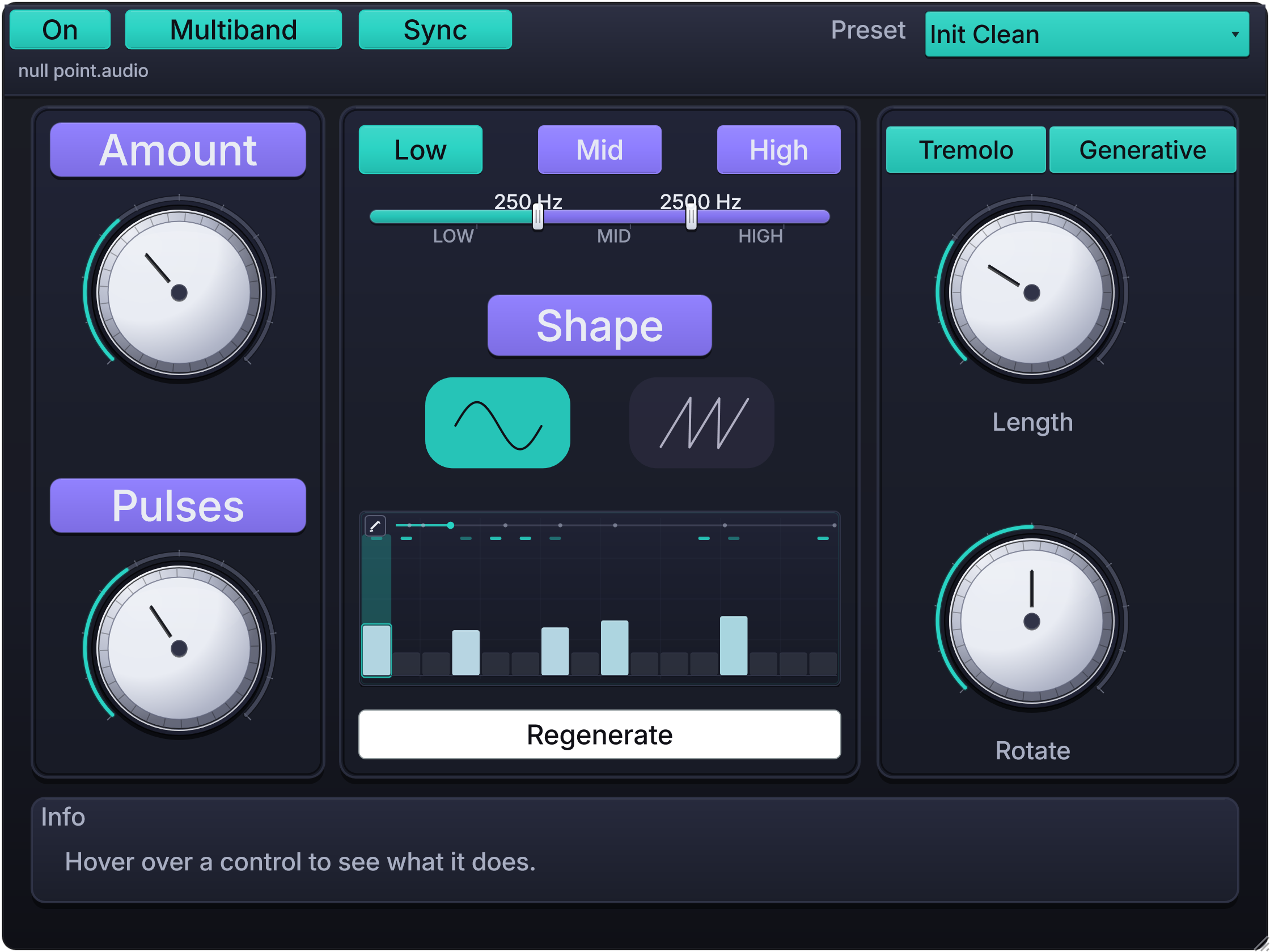
Not a tremolo with extra steps. Two kinds of movement, three ways to drive them, three bands to aim them at — each part simple on its own, wired together into something bigger.
Tremolo moves volume. Vibrato moves pitch — a short delay line read slightly early or late, six milliseconds of it, swinging up to four more. Sine for a rounded shape, triangle for a straight one. Chaos loosens the timing so it breathes; Flux drives the curve until it leans. Neither replaces rate or depth. They bend what is already there.
Three ways to drive the movement. Classic is a continuous LFO — the tremolo and vibrato you already know. Euclidean spreads hits as evenly as the maths allows, the pattern behind son clave and techno hats. Generative scores its own, favouring downbeats and subdivisions, refusing to clump. Hit Regenerate for a new one; the density and phrase length you set stay put.
The part people miss. A Euclidean or generative pattern doesn't have to chop the level — point it at vibrato and it opens and closes the distance between the dry signal and the pitch-shifted one instead. Low Amount pulses the wobble gently. High Amount lets pitch move on the accents only. Rhythm you can hear without anything getting quieter.
One signal, three bands, three personalities. Linkwitz-Riley crossovers at 250 Hz and 2.5 kHz by default, draggable mid-playback without a jump. Every band carries its own mode, source, waveform, rate, depth and pattern — classic tremolo in the lows, Euclidean in the mids, vibrato up top. Variation spreads one rhythm across all three: lows kept simple, highs busier.
Rhythmic gating eats low end. So the low band is measured against an unmodulated copy of itself, and when the movement pulls it under the floor — nine decibels down, by default — it gets pushed back up. The groove stays; the weight stays with it. On by default, and it steps aside when the low band is running vibrato.
Sync follows the DAW: rate snaps to divisions from two bars down to 1/32, patterns run a quarter bar to eight and ride the transport. Nothing switches hard — bypass, mode, waveform, crossovers and multiband itself are crossfaded, so you can automate all of it and hear none of the seams. SSE on Intel, NEON on ARM, scalar where there is neither.
As much power as the sound needs, and not one menu more. Every control sits on the panel in plain sight — load a preset, start turning, skip the hunt through nested pages.
Nothing adds delay unless you switch on something that needs it. What you play is what you hear, in time.
Buy it, own it. No login and no licence server — it works offline, with free updates for the life of the plugin.
Pick the one you'd actually reach for. Every vote is counted, and the winner is the next thing we build.